How to Write a Government Contract Proposal, Step by Step
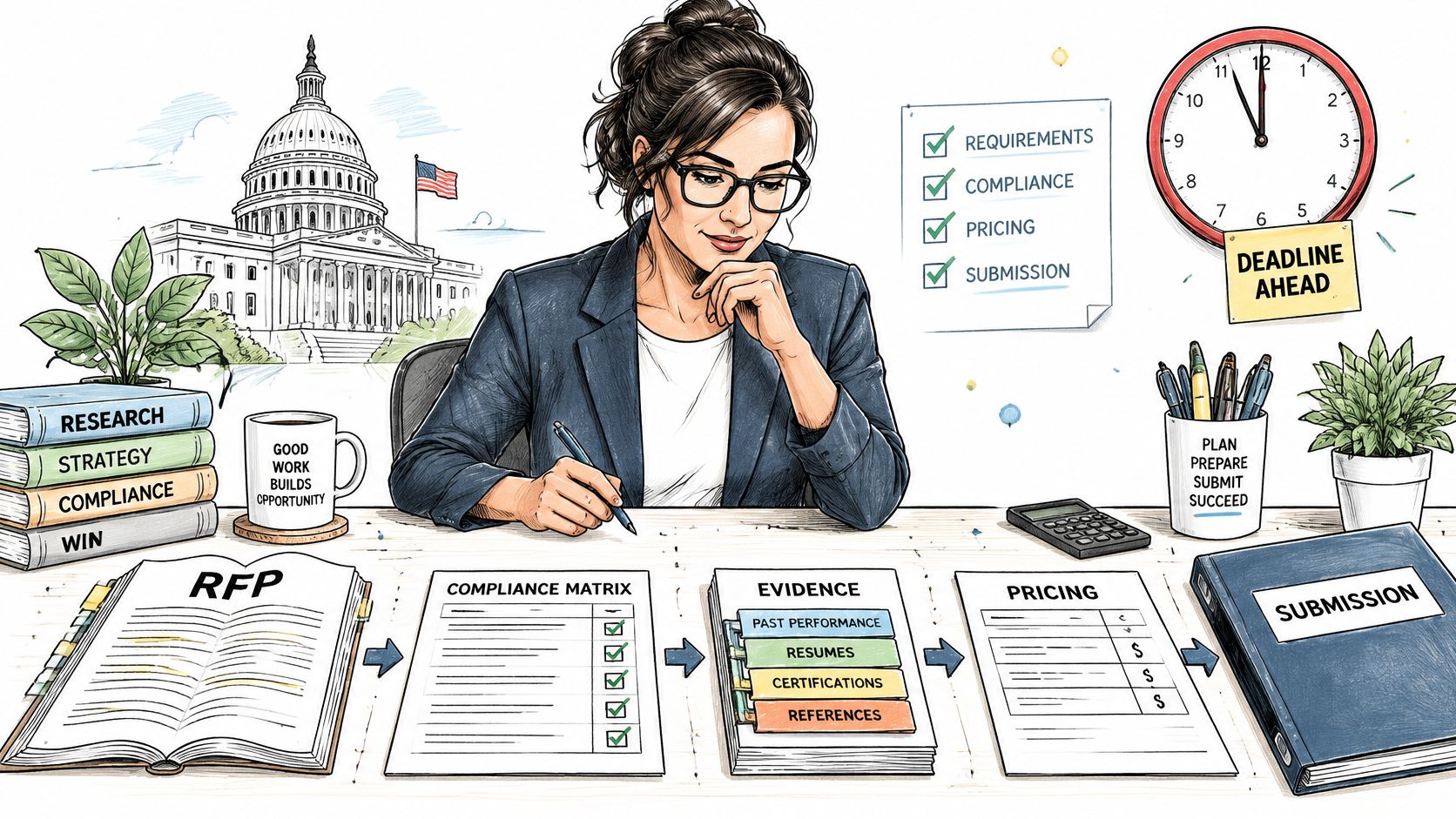
The usual advice about how to write a government contract proposal starts with telling a compelling company story. That's the wrong starting point. A polished narrative won't rescue a response that answers questions the evaluator never asked or leaves a required instruction unanswered.
Start with the solicitation's scoring logic, then work backward to the outline, evidence, staffing, and price. This guide focuses on U.S. federal negotiated procurements. For state opportunities or federal solicitations using a different format, apply the same discipline to the instructions and evaluation criteria provided.
Table of Contents
- Read Sections L and M Before You Write
- How to Build a Compliance Matrix Step by Step
- Plan Win Themes and Evidence for Each Factor
- Draft Each Volume Against the Evaluation Factors
- Red-Team Review and Pre-Send Checklist
- Submitting on Time and Tracking Amendments
- Decide Your First Three Moves This Week
Read Sections L and M Before You Write
Evaluators assess your response against the solicitation, not your preferred sales presentation. Under FAR 15.305, agencies assess proposals and offerors' ability to perform successfully, comparing competitive proposals solely against the stated factors and subfactors, using approaches that may include adjectival ratings, numerical weights, or ordinal rankings.
That distinction changes your writing priorities. A company-history paragraph deserves space only when it supports something the government will evaluate. A less elegant paragraph that explains a required transition method, identifies its owner, and provides evidence is more useful than an impressive but irrelevant introduction.
Section L controls what you submit and how you submit it. Section M controls how the government evaluates it. Read them together, with the statement of work and pricing instructions beside them.
Where Each Solicitation Part Shapes Your Proposal
| Solicitation part | What it controls | What you do with it |
|---|---|---|
| Section L (instructions) | Format, volumes, page limits, required attachments | Build the proposal outline and budget pages per volume |
| Section M (evaluation) | Factors, subfactors and relative importance | Set section headings and win themes in weight order |
| Statement of work or performance work statement | Deliverables, schedule and performance standards | Turn each requirement into a claim with a measurable target |
| Price schedule or cost volume | Pricing structure, labor categories and option years | Reconcile against staffing and schedule assumptions |
| Amendments | Changed instructions, dates or evaluation factors | Re-check the matrix and update every affected section |
Don't confuse the importance of a requirement with the amount of prose it needs. An unsigned form may require little writing but still demand immediate attention. A missing volume or an exceeded page limit isn't a weak idea. It's a failure to follow an instruction.
Small firms should also distinguish eligibility from evaluated participation. Small-business prime contractors received $183.5 billion, representing 28.76% of total U.S. federal contracting dollars in FY2024, according to SmallGovCon's federal contracting scorecard report. That opportunity doesn't mean your certification earns evaluation credit unless the solicitation says it does.
Practical rule: Separate what makes you eligible, what makes your response compliant, and what makes your offer competitive.
For a document-reading exercise, examine the AFRL industry guide and proposal preparation instructions, then verify the governing documents for your own opportunity. Before opening a blank draft, print or annotate the RFP, highlight every submission instruction and evaluation factor, and record their stated order of importance.
How to Build a Compliance Matrix Step by Step
A compliance matrix is your working control sheet, not an attachment you create after writing. It connects the government's instructions to the exact response and evidence your team must produce.
FAR Subpart 15.2 separates proposal instructions from significant evaluation factors and their relative importance; cost or price is normally considered in negotiated source selections unless a regulatory exception applies. Build your spreadsheet around that separation so administrative compliance and evaluated substance remain visible.
Build the Working Sheet
Download the complete package. Save the solicitation, attachments, questions and answers, and amendments with version dates. Don't let writers work from different document sets.
Create the control columns. Include requirement or factor, response location, supporting evidence, submission status, and source reference. Add an owner and internal deadline so unresolved rows belong to someone.
Break instructions into individual rows. Capture content requirements alongside font, file type, naming, signature, and attachment rules. A row containing several obligations is difficult to verify.
Add evaluation factors and subfactors. Record their stated importance without inventing numerical weights. Preserve the solicitation's wording so reviewers can compare the draft directly.
Assign a response location and proof item. Identify the volume and section during outlining, then add the final page reference after export. Budget space according to evaluation importance while preserving room for every mandatory response.
Use meaningful status labels. Not started, Drafting, Evidence needed, and Done distinguish writing progress from missing support. A complete paragraph with unverified claims is still Evidence needed.
Control amendments. Record each amendment's date and identify affected rows. Reopen completed items when revised instructions change the required answer.
Use this visual as a reference when setting up the sheet.
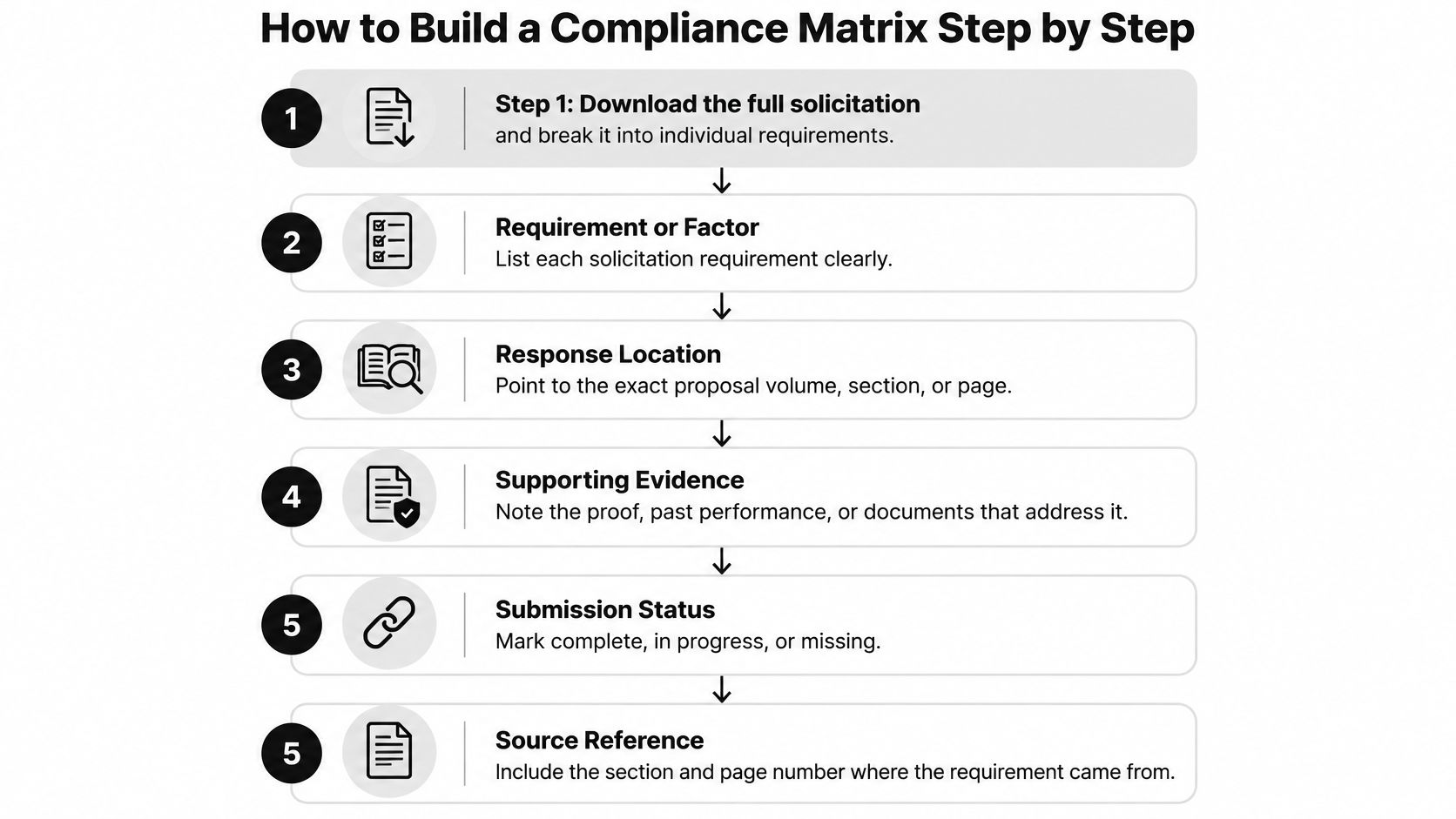
A row labeled technical approach with no response location isn't actionable. Replace it with the particular requirement, intended subsection, evidence owner, and expected proof. That lets the proposal manager identify a missing answer before it becomes a last-minute rewrite.
For small teams, Excel or Google Sheets is enough. A carefully maintained spreadsheet is more useful than elaborate software nobody updates. Record deadline time zones explicitly, and keep requirement status separate from file-upload status.
The column people are most tempted to omit is supporting evidence. Keep it: a page reference tells you where an answer appears, but not whether the answer is credible.
Plan Win Themes and Evidence for Each Factor
A claim without a baseline or measurement is often just an adjective. Reliable and responsive describe aspirations unless you explain what the government receives and how you'll demonstrate delivery.
Build a weighted win-theme sheet by ranking non-cost factors according to their stated importance. Give each high-value factor a relevant differentiator, supporting proof, and named evidence owner. The FAR overhaul Part 15 deviation guide provides the source-selection context for considering price or cost alongside quality-related factors; follow the rules and evaluation approach applicable to your solicitation.
Common Evaluation Factors and the Proof to Bring
| Factor | Proof to bring | Weak version to avoid |
|---|---|---|
| Technical approach | Method with milestones, tools and quality checks | Generic methodology with no schedule |
| Past performance | CPARS ratings, contract values and customer references | Projects unrelated to the solicitation's scope |
| Management capability | Org chart, escalation path and QA process | Unnamed managers and vague oversight |
| Key personnel | Résumés matched to labor categories and certifications | Placeholder names or unfilled roles |
| Small business participation | Subcontracting plan, certifications and named partners, where requested | Commitment with no percentages or partners |
| Cost or price | Labor build-up tied to staffing and schedule | Low price with no credible staffing model |
For a proposed improvement, distinguish historical results from future commitments. Historical results need records. Future commitments need a credible method, resources, and acceptance criteria.
Say you're proposing to reduce invoice errors. Establish the baseline from validated records, define the target, identify the accounting log used for measurement, assign a reporting frequency, and specify what triggers corrective action. If the baseline is unknown, describe how you'll establish it rather than inventing one.
Accessibility deserves explicit attention on information and communications technology bids. In FY2024, 46% of reporting U.S. federal entities said they regularly, frequently, or almost always included Section 508 accessibility in technical evaluations of ICT proposals, according to GSA's Section508.gov acquisition findings. Add an accessibility evidence row for an ICT bid and identify the solicitation's actual requirements rather than assuming a generic compliance statement is sufficient.
A differentiator matters only when it addresses an evaluated need and you can substantiate it.
Small firms may have strong commercial work but limited federal records. Select examples for relevant scope, complexity, and outcomes, subject to the solicitation's instructions. Don't disguise a partner's work as your own or stretch an unrelated project into a matching reference.
Finish with a theme sheet your team can use during drafting. If a differentiator lacks proof, change the claim or assign the evidence gap. Don't turn it into confident boilerplate.
Draft Each Volume Against the Evaluation Factors
Replace vague promises with observable work. Instead of writing that you'll provide regular status reports, describe the report's contents, responsible role, delivery point, and review process using the solicitation's actual requirements.
For example, if the attachment requires a monthly report, your response might explain that the project manager prepares it, the quality lead checks its metrics, and the government receives it through the designated channel. Don't add an attractive delivery commitment until the delivery team confirms it's feasible and priced.
Keep the governing documents beside the draft while you work.
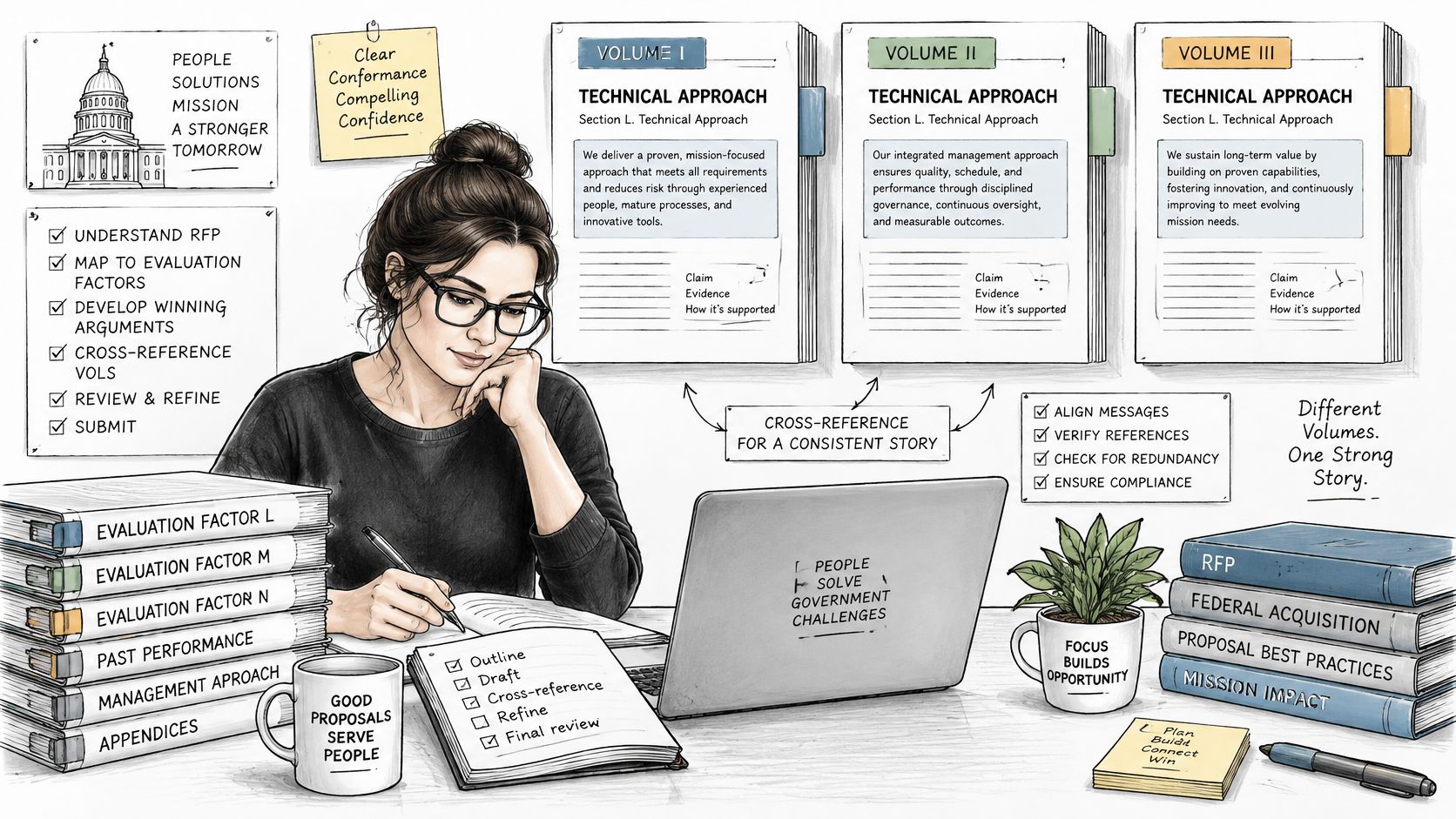
Make Each Factor Easy to Assess
Use the evaluation factor's name as the heading when the prescribed format permits it. Open with a concise answer, then explain execution, provide evidence, and describe verification.
- Answer the requirement. State what you'll do without making the evaluator infer your commitment.
- Explain execution. Identify the responsible role, sequence, dependencies, tools, and quality checks.
- Support the approach. Insert relevant records, credentials, or process evidence.
- Define verification. Explain how the government can confirm completion or performance.
Don't distribute pages equally by habit. Reserve enough space for each mandatory answer, then give the more important or technically complex factors the detail they need. Cut repeated company descriptions before removing explanation from an evaluated approach.
A draft RFP listing for Human Resource Solutions Gen VI IDIQ contracts can serve as a practice document set for identifying response structure. Treat draft material as preparation, not as a substitute for final solicitation instructions.
Reconcile the Delivery Model
Maintain a shared assumptions sheet for staffing levels, labor categories, travel, materials, schedule, and option-year escalation. The technical writer and pricing owner should use the same approved version.
If the technical volume promises backup coverage but the pricing model includes no resources to provide it, resolve the delivery decision. Don't merely edit the wording until the contradiction becomes harder to spot.
For a supplementary walkthrough of proposal preparation, use the video below alongside the solicitation.
Draft a complete evaluated factor before expanding the rest. Ask someone to assess it using the solicitation language alone. If they can't locate the method, evidence, and commitment, fix the structure before repeating it across every volume.
Red-Team Review and Pre-Send Checklist
Check the exported submission, not just the working document. PDF conversion can change pagination, split tables, displace signatures, or make graphics unreadable. Count pages using the solicitation's rules, including any exclusions for covers or supporting material.
If a volume exceeds its limit, remove repetition first. Then reduce detail in lower-weight areas without deleting required answers. Shrinking text below the permitted size isn't a solution.
Use the final-file checklist during export and approval.
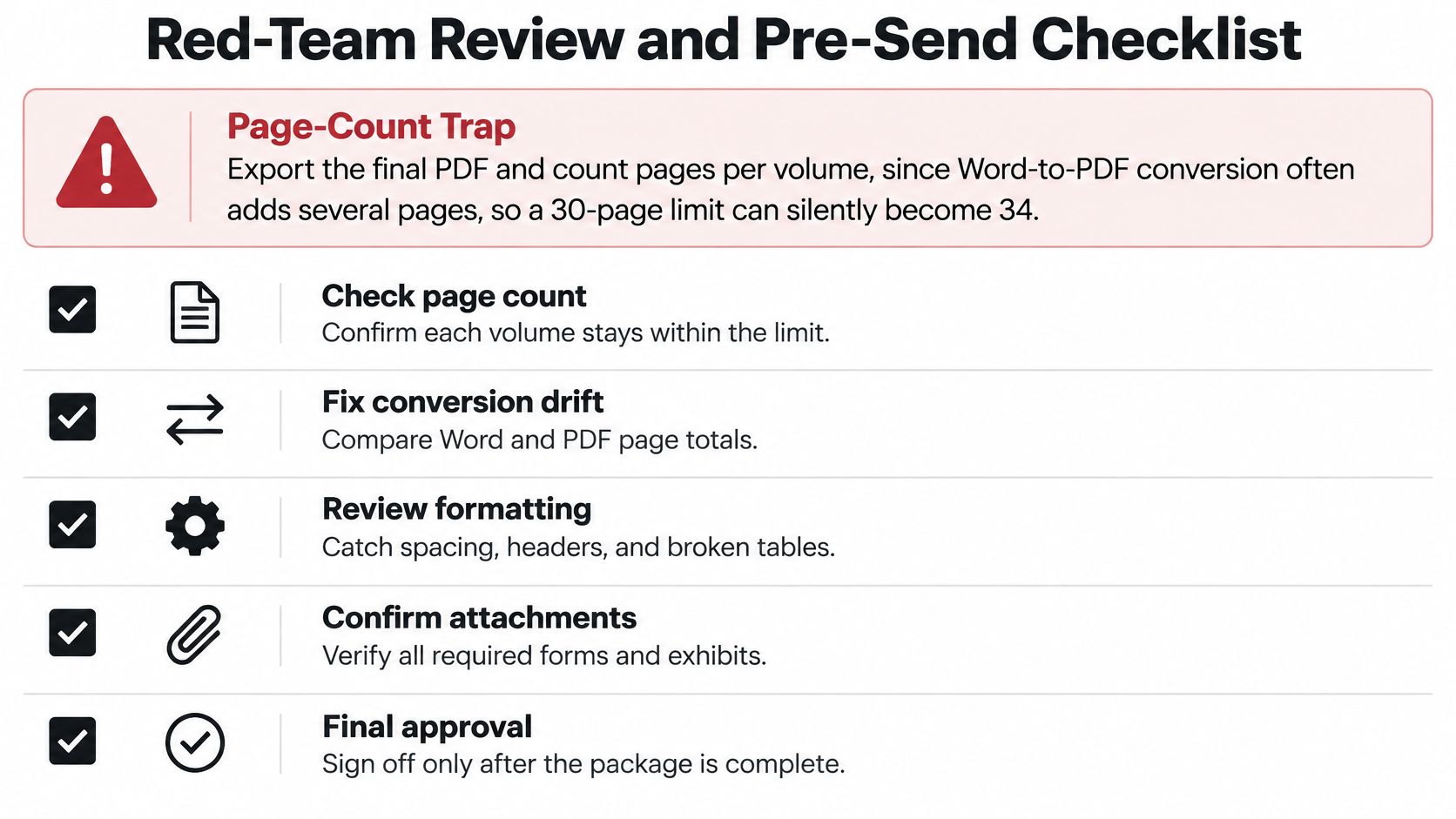
Review Like an Evaluator
Assign the red-team review to someone who didn't write the draft. Give them the solicitation, matrix, evidence records, and exported files. Ask them to identify what deserves credit, what remains unsupported, and what creates performance risk.
Schedule that review early enough to change the solution, not merely polish sentences. A missing transition plan may require operational decisions and pricing changes that a proofreader can't make.
Pre-Submission Failures and How to Catch Them
| Failure | How to catch it | Fix before submitting |
|---|---|---|
| Page limit exceeded after PDF conversion | Export the final PDF and count pages per volume | Trim the lowest-weight factor first, preserving mandatory content |
| Numeric claim with no source | Trace each figure to a record or attachment | Replace with a sourced figure or mark a gap for resolution |
| Price does not match staffing | Reconcile labor hours line by line against the cost volume | Adjust staffing or pricing so both match |
| Required certification missing | Check Section L against the matrix | Obtain and attach the document |
| Wrong file name or format | Compare file rules in Section L against each export | Rename and re-export |
Read the submission instructions aloud during the final compliance meeting. Small phrases about separate volumes, copies, attachments, or signatures deserve the same attention as technical requirements. Mark each instruction only after checking the actual deliverable.
At BidFunnels, our free RFP checker can check an RFP without signup. We're a research and drafting tool, not a submission service or your agent before a government body. Users must review and edit our drafts and remain responsible for what they submit.
Approve the Actual Package
- Close every matrix row. Mark it Done only when the final response or required attachment is present, with an accurate location.
- Read the exported files. Have someone outside the writing team check them from beginning to end.
- Approve the cost reconciliation. Confirm that the priced resources support the technical commitments.
- Verify file rules. Check names, formats, readability, and required separation of volumes.
- Confirm authorization. Inspect certifications, signature blocks, and required approvals.
After approval, freeze the package. Any substantive change should trigger a targeted recheck of affected requirements, pricing, and pagination.
Submitting on Time and Tracking Amendments
A deadline entered in the wrong time zone is still the wrong deadline. Record the government's stated time zone and your team's local equivalent in the submission log, then have another person verify the conversion. Don't rely on a calendar application's default settings.
Confirm the submission channel before deadline day. Test access to the named portal, identify who is authorized to upload, and check the solicitation's registration requirements, including any applicable SAM.gov status requirements. Don't assume the site where you found the notice is where you submit the proposal.
Prepare the Upload Record
Keep the submission log with the approved package. It should record:
- Governing version. Identify the solicitation and amendments used to prepare the response.
- Submitted files. List exact filenames, version dates, and the person approving each file.
- Deadline details. Record the date, time, time zone, and designated submission channel.
- Receipt evidence. Save the confirmation, timestamp, and any portal status showing completion.
Set an internal submission deadline with enough buffer to resolve access or file problems. An upload in progress isn't the same as a completed submission. Check the portal's stated completion process and preserve its receipt.
Check Changes Before Sending
Check the official notice for amendments before uploading. A changed instruction may affect more than the deadline: it can alter the response format, required evidence, or evaluation approach.
An amendment notice addressing solicitation questions illustrates why question responses belong in document control, not just someone's inbox. Route clarification questions through the contracting officer's specified channel and distinguish informal guidance from governing solicitation changes.
After submission, retain the exact package and receipt together. When an award notice arrives, promptly check the applicable debriefing instructions and request deadline rather than assuming you can respond later.
Create the log before uploading anything. Reconstructing filenames, approvals, and timestamps afterward is avoidable work.
Decide Your First Three Moves This Week
Start with the complete solicitation package, not an old proposal you hope to adapt. Build the requirement rows, identify evidence gaps, and test a complete factor response before committing the team to full production.
That test gives a small firm a useful decision point. If you can't support a central requirement, secure the missing capability, revise the approach where permitted, or reconsider the bid. More writing won't fix a solution your team can't deliver.
Make the Decisions That Control the Draft
Choose which factors deserve the strongest emphasis. Rank them by Section M's stated importance, then decide where your offer has a defensible advantage. Don't let the easiest section consume the writing schedule merely because its content is already available.
Name the owner of each evidence item. Put an actual person beside every requested résumé, reference, performance record, and process document. Give that person a clear definition of what the writer needs, not a vague request for background information.
Set the internal submission deadline. Record its time zone and protect time for review, correction, export, approval, and upload. Assign a backup for the person responsible for submission so access doesn't depend on someone's availability.
The useful outcome this week isn't a large page count. It's a controlled bid with known requirements, credible evidence, an executable delivery model, and owners for unresolved work.
When someone scores the test section, ask where they would award credit and where they still have questions. Their difficulty finding an answer is a drafting problem worth fixing before it spreads.
Evaluators score against the solicitation, so every page should answer a question the evaluator asked.
Visit BidFunnels to organize solicitation requirements and prepare proposal sections from your own supporting files. Use the source-linked compliance matrix and editable drafts to build a response your team can verify, review, and submit with confidence.